Before you begin. This procedure is general reference information, not professional advice. Equipment varies by manufacturer, model, and year. Always follow the documentation supplied with your equipment — where it differs from this page, follow the manufacturer. Verify that you have the tools, the working conditions, and the ability to do this task safely. If anything is unclear, if the equipment is damaged, or if the task exceeds your experience, stop and use a qualified professional. You are responsible for your own safety and for the outcome. This site accepts no liability for any loss, damage, or injury arising from the use of this information.
Specifications marked unverified could not be traced to a manufacturer source. Do not rely on them — obtain the value from your equipment documentation.
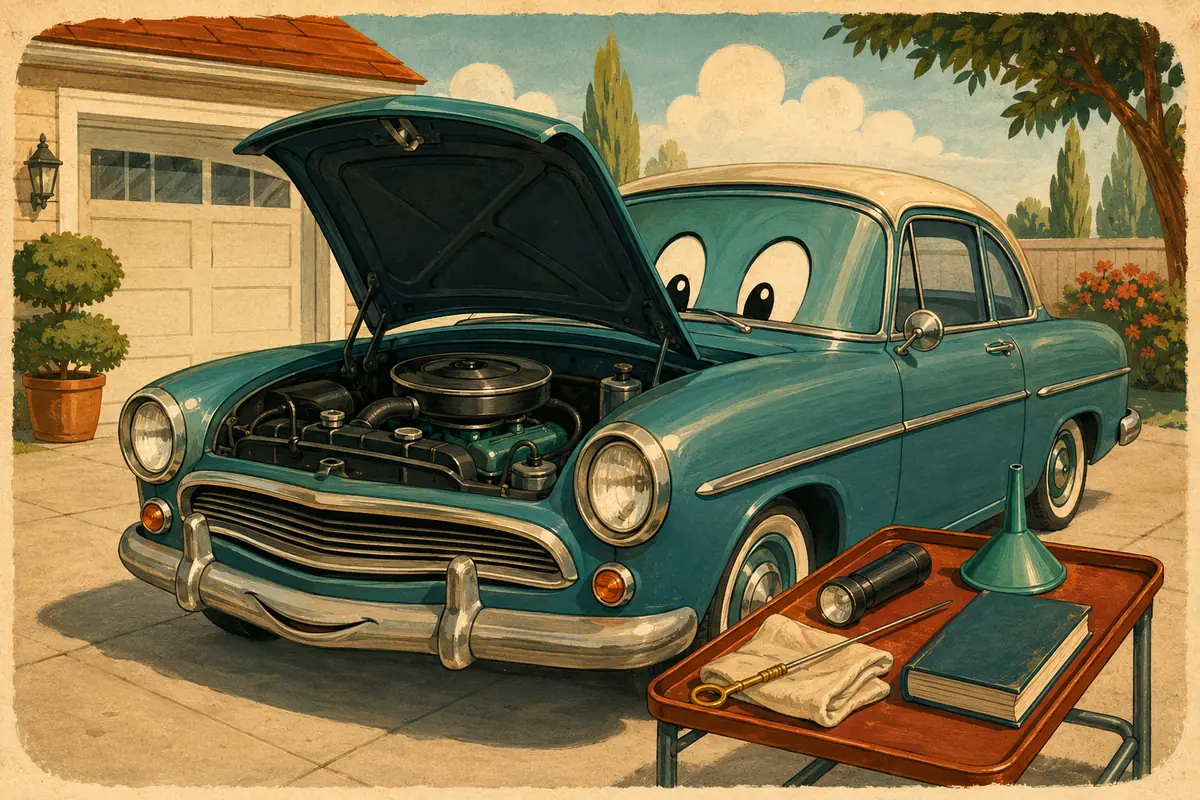
Summary
Checking the oil is two jobs that people run together. The first is a measurement: is there enough oil in the engine right now. The second is a specification question: which oil does this engine take when you need to add some. This page keeps them apart, because the measurement is the same on almost every car with a dipstick and the specification is different on almost every car — sometimes different between two engines in the same model, in the same year.
What this page will not print is a viscosity grade, an oil standard or a capacity for your engine. Those come from your own vehicle documentation and from the label on the oil filler cap, and a page that guessed one would be guessing with the thing that actually damages an engine. There is one more honest wrinkle. Manufacturers do not agree on the state the engine should be in when you read the dipstick: Mazda asks you to warm the engine, stop it and wait at least five minutes, while Subaru simply asks you to park level, switch off and wait a few minutes. Both are on this page, neither is averaged, and your own manual is the tie-breaker.
Necessary equipment
| Item | Note |
|---|---|
| Clean cloth | Use a cloth that does not leave material on the dipstick. |
| Flashlight optional | The light in the engine compartment is often low. |
| Funnel optional | A funnel prevents a spill at the oil filler. |
| Pen and paper optional | Record the level and the date after each check. |
| Vehicle documentation | The documentation gives the oil for this engine. |
| Engine oil material | Use only the oil that the vehicle documentation specifies. |
Specifications
No tier-1 source was found for this value. Take it from the documentation supplied with your equipment.
Prepare the vehicle
Estimated 7 min to 11 min
No tier-1 source was found for this value. Take it from the documentation supplied with your equipment.
STOP THE VEHICLE ON A LEVEL SURFACE AWAY FROM TRAFFIC.
Traffic can kill you.
- Stop the vehicle on a level surface away from traffic.<1mReport a problem with step 1, Prepare the vehicle
- A slope moves the oil in the pan and gives a wrong reading.
- Set the parking brake.<1mReport a problem with step 2, Prepare the vehicle
SET THE IGNITION TO OFF BEFORE YOU OPEN THE HOOD.
The cooling fan can start with no warning. The fan can injure your hand.
- Set the ignition to off.<1mReport a problem with step 3, Prepare the vehicle
- Read the condition that the vehicle documentation gives for this measurement.2mReport a problem with step 4, Prepare the vehicle
- Mazda gives a warm engine, then a wait of at least 5 minutes after you stop it.
- Subaru gives a level surface, a stopped engine, and a wait of a few minutes.
- The two instructions are not the same. Use the instruction for your own vehicle.
- Wait for the period that your documentation gives.5mReport a problem with step 5, Prepare the vehicle
- The oil goes down to the pan in this period.
Open the hood
Estimated 1 min to 3 min
- Pull the hood release inside the vehicle.<1mReport a problem with step 1, Open the hood
- The release is usually below the instrument panel on the driver side.
THE ENGINE AND THE PARTS NEAR IT CAN BE VERY HOT.
A hot part can burn your skin. Let the engine become cool before you touch a part.
- Release the second latch below the front edge of the hood.<1mReport a problem with step 2, Open the hood
- Lift the hood.<1mReport a problem with step 3, Open the hood
- If the hood has a support rod, put the rod in its hole.<1mReport a problem with step 4, Open the hood
Read the level on the dipstick
Estimated 3 min to 5 min
No tier-1 source was found for this value. Take it from the documentation supplied with your equipment.
- Find the dipstick for the engine oil.<1mReport a problem with step 1, Read the level on the dipstick
- The handle of the dipstick has a different colour on many vehicles.
- The vehicle documentation shows the position for your engine.
- Remove the dipstick from the tube.<1mReport a problem with step 2, Read the level on the dipstick
- Clean the dipstick with a cloth.<1mReport a problem with step 3, Read the level on the dipstick
- Install the dipstick fully into the tube.<1mReport a problem with step 4, Read the level on the dipstick
- Mazda tells owners to put the dipstick in fully, and to make the O-ring correct first.
- Remove the dipstick again.<1mReport a problem with step 5, Read the level on the dipstick
- Hold the dipstick in a horizontal position.<1mReport a problem with step 6, Read the level on the dipstick
- The oil moves along a dipstick that you hold at an angle.
- Find the two marks at the end of the dipstick.<1mReport a problem with step 7, Read the level on the dipstick
- Some dipsticks show the words MIN and MAX.
- Some dipsticks show the letters L and F.
- Some dipsticks show two holes or two notches.
- Look at the two faces of the dipstick.<1mReport a problem with step 8, Read the level on the dipstick
- Subaru tells owners to use only the lower of the two readings.
- Read the level of the oil against the two marks.<1mReport a problem with step 9, Read the level on the dipstick
- The level is correct if the oil is between the two marks.
- The level is low if the oil is at the lower mark or below it.
Add oil if the level is low
Estimated 4 min to 18 min
No tier-1 source was found for this value. Take it from the documentation supplied with your equipment.
USE ONLY THE OIL THAT THE VEHICLE DOCUMENTATION SPECIFIES.
The wrong oil can cause damage to the engine.
- If the level is low, get the oil that the vehicle documentation specifies.1mReport a problem with step 1, Add oil if the level is low
- Do not use a different oil because a shop or a web page suggests it.
- Remove the cap from the oil filler.<1mReport a problem with step 2, Add oil if the level is low
- The oil filler cap is on the top of the engine, and it is not the dipstick.
DO NOT SPILL OIL ON THE ENGINE.
A spill of oil on a hot part can catch fire.
- Add the oil in small quantities.1mReport a problem with step 3, Add oil if the level is low
- Use a funnel to prevent a spill.
- Subaru tells owners to add the oil slowly.
DO NOT PUT MORE OIL THAN THE UPPER MARK SHOWS.
Mazda tells owners that too much oil can cause damage to the engine.
- Do a new measurement of the level after each quantity.1mReport a problem with step 4, Add oil if the level is low
- Do steps s11 to s18 again for each new measurement.
- Stop when the level is at the upper mark.<1mReport a problem with step 5, Add oil if the level is low
- Install the cap on the oil filler.<1mReport a problem with step 6, Add oil if the level is low
Find the oil for this engine
Estimated 2 min to 6 min
No tier-1 source was found for this value. Take it from the documentation supplied with your equipment.
No tier-1 source was found for this value. Take it from the documentation supplied with your equipment.
- Read the oil that the vehicle documentation specifies for this engine.2mReport a problem with step 1, Find the oil for this engine
- Mazda gives one oil for one engine and a different oil for a second engine in the same model.
- The documentation gives a viscosity grade and a quality designation.
- Read the label on the oil filler cap.<1mReport a problem with step 2, Find the oil for this engine
- If the label and the documentation do not agree, do not add oil. Speak to a dealer for your make.<1mReport a problem with step 3, Find the oil for this engine
- A change of engine or a change of owner can make the two disagree.
Close the vehicle
Estimated 2 min
- Install the dipstick fully into the tube.<1mReport a problem with step 1, Close the vehicle
- Remove your hands and the cloth from the engine compartment.<1mReport a problem with step 2, Close the vehicle
- Close the hood.<1mReport a problem with step 3, Close the vehicle
- Record the date, the level, and the quantity of oil that you added.<1mReport a problem with step 4, Close the vehicle
Terminology
This page uses one term for each item and holds it throughout, as ASD-STE100 requires. Equipment sellers and other guides use the names below for the same parts.
- dipstick
- Also called: oil level gauge, oil stick, engine oil dipstick, the stick you pull out to check the oil
- engine oil
- Also called: motor oil, car oil, engine lubricant, 5w30, 0w20
- viscosity grade
- Also called: oil weight, oil grade, SAE grade, what oil does my car take
- oil filler cap
- Also called: oil cap, where you pour the oil in, engine oil cap
- hood
- Also called: bonnet, the front lid, engine cover
- engine oil level warning lamp
- Also called: oil light, low oil light, oil can light, engine oil low warning light
When to use a professional
Stop if the oil is above the upper mark. Too much oil can cause damage. Speak to a vehicle repair shop before you drive.
Stop if the oil on the dipstick has a milky colour. Stop if the level goes down quickly between checks. Stop if you see oil below the vehicle. Speak to a vehicle repair shop.
Stop if the warning lamp for the oil pressure comes on. Do not drive the vehicle. Speak to a vehicle repair shop immediately.
This page does not give an oil for your vehicle. Only the vehicle manufacturer gives that. Read the documentation for your vehicle, or speak to a dealer for your make.
Common questions
How do I check my engine oil?
Park on level ground, switch the engine off, and wait for the period your own manual gives before you touch the dipstick. Pull the dipstick out, wipe it clean, push it all the way back in, and pull it out again — the first reading off an unwiped stick is oil splashed up the tube, not the level in the pan. Hold it flat and read where the oil film ends against the two marks. Subaru adds a detail most people miss: look at both faces of the dipstick and believe the lower of the two readings.
Should the engine be hot or cold when I check the oil?
It depends on who built your car, and this page will not pretend otherwise. Mazda's owner's manual tells you to warm the engine to normal operating temperature, turn it off, and wait at least five minutes for the oil to drain back into the pan. Subaru's own guidance tells you to park level, turn the engine off, and read the dipstick after a few minutes, with no instruction to warm it first. Those are genuinely different instructions and averaging them would give you a procedure neither company endorses. Read the manual for your own car and follow that one.
What oil does my car take?
Your manual and the label on the oil filler cap, and nowhere else. The grade is not a property of the brand or the model — it is a property of the specific engine, and manufacturers routinely specify different oils for two engines offered in the same car in the same year. Mazda's 2025 Mazda3 manual is a clean example: one viscosity grade for one engine and a different one for the other, in the same book. A parts-shop lookup table, a comment thread or a page like this one is not a substitute for the document that came with the vehicle.
Why does the manual say one grade and the cap say another?
Usually because the car has changed hands, changed engine, or been serviced by somebody who fitted the wrong cap. It happens more often than people expect on older cars. When the two disagree, do not split the difference and do not assume the newer-looking one is right. Stop, and ask a dealer for your make to confirm the grade against the vehicle identification number. Adding the wrong oil is cheap to avoid and expensive to fix.
I overfilled it. Does that matter?
Yes. Mazda's manual carries a plain caution not to overfill because it may cause engine damage, and every other manufacturer says a version of the same thing. Oil above the upper mark can be whipped into foam by the moving parts inside the engine, and foam does not lubricate the way liquid oil does. This is not a page that can talk you through removing the excess safely, and the honest answer is that a repair shop should drain it back to the mark before you drive.
How often should I check it?
More often than you change it. Subaru's framing is a good one: check the level regularly between oil changes, because the point is to catch a slow loss before it becomes a fast one. A monthly check, and a check before any long journey, costs about five minutes. Toyota's advice on the related question of when to change the oil is the same shape — the interval depends on the vehicle, the engine and the oil, and the owner's manual is the only reliable place to get it.
My car has no dipstick. What now?
Some newer vehicles have replaced the dipstick with an electronic level readout in the instrument cluster, and this page does not cover them. The procedure for those is model-specific, it usually requires the vehicle to be level and at a particular temperature, and the manual is the only source for it. If you cannot find a dipstick after checking the manual, do not go looking for another tube to put something into — ask a dealer for your make.
Related procedures
- Check an automatic transmission fluid level, or establish that the transmission is sealed and has no dipstick
- How to check your coolant level without opening the radiator cap
- How to change the engine air filter in your car
- What does the oil pressure warning light mean, and is it the same as the low oil light?
- How to check and change pressure washer pump oil, and how to tell if your pump even has oil
- How to check your tire pressure and put the right amount of air in your tires
- How to reset the service light, oil change light or maintenance required light on a car after an oil change
- How to change the cabin air filter in a car when the air conditioning smells or barely blows
Sources
Every specification on this page is traced to one of these sources. Tier 1 is a manufacturer document, a published standard, or a government safety authority. See Standards for the full tiering rule.
- Tier 1Inspecting Engine Oil — 2025 Mazda3 Owner's Manual
- Tier 1Inspecting Engine Oil Level — 2022 Mazda CX-30 Owner's Manual
- Tier 1Car Care Tips — How to Check Engine Oil
- Tier 1How To Tell If You May Need An Oil Change
Revision history
Current version 1 · updated 2026-07-29 · next review due 2027-07-29
- v1 · 2026-07-29First draft. Every per-vehicle value publishes as consult-the-documentation: the viscosity grade, the quality designation, the capacity, and the quantity between the two dipstick marks. The dipstick method rests on Mazda's owner's manual and on Subaru's owner guidance. Those two sources give materially different preconditions for the reading, so the disagreement publishes as a conflict_note naming both rather than being reconciled or averaged.
Corrections to this page are listed in the public corrections log. Reports that are credible and not yet verified are listed in the public errata register, and an open one renders above the step it concerns.
Comments and corrections
Found an error? A correction with a manufacturer source is applied and logged publicly. You can also write to corrections@fixchecklist.com.
Every step above carries its own report control, which tags the report with that step so a correction reaches the right place. For anything about the procedure as a whole — the order of the sections, a step that is missing, something that did not match your equipment — use this: report something about this whole procedure.