Before you begin. This procedure is general reference information, not professional advice. Equipment varies by manufacturer, model, and year. Always follow the documentation supplied with your equipment — where it differs from this page, follow the manufacturer. Verify that you have the tools, the working conditions, and the ability to do this task safely. If anything is unclear, if the equipment is damaged, or if the task exceeds your experience, stop and use a qualified professional. You are responsible for your own safety and for the outcome. This site accepts no liability for any loss, damage, or injury arising from the use of this information.
Specifications marked unverified could not be traced to a manufacturer source. Do not rely on them — obtain the value from your equipment documentation.
Summary
Almost everybody searching for this wants to clean the filter and put it back. The manufacturers do not publish that. Briggs & Stratton's own instructions for all three of its element types — paper, foam and dual element — say remove the old one, discard it and fit a new one, and Toro's operator manual says replace the air-filter element every 25 hours. Not one of the manufacturer documents behind this page gives a method for washing a filter and reusing it. That is the single most useful thing on this page, and it is why the page is titled the way it is.
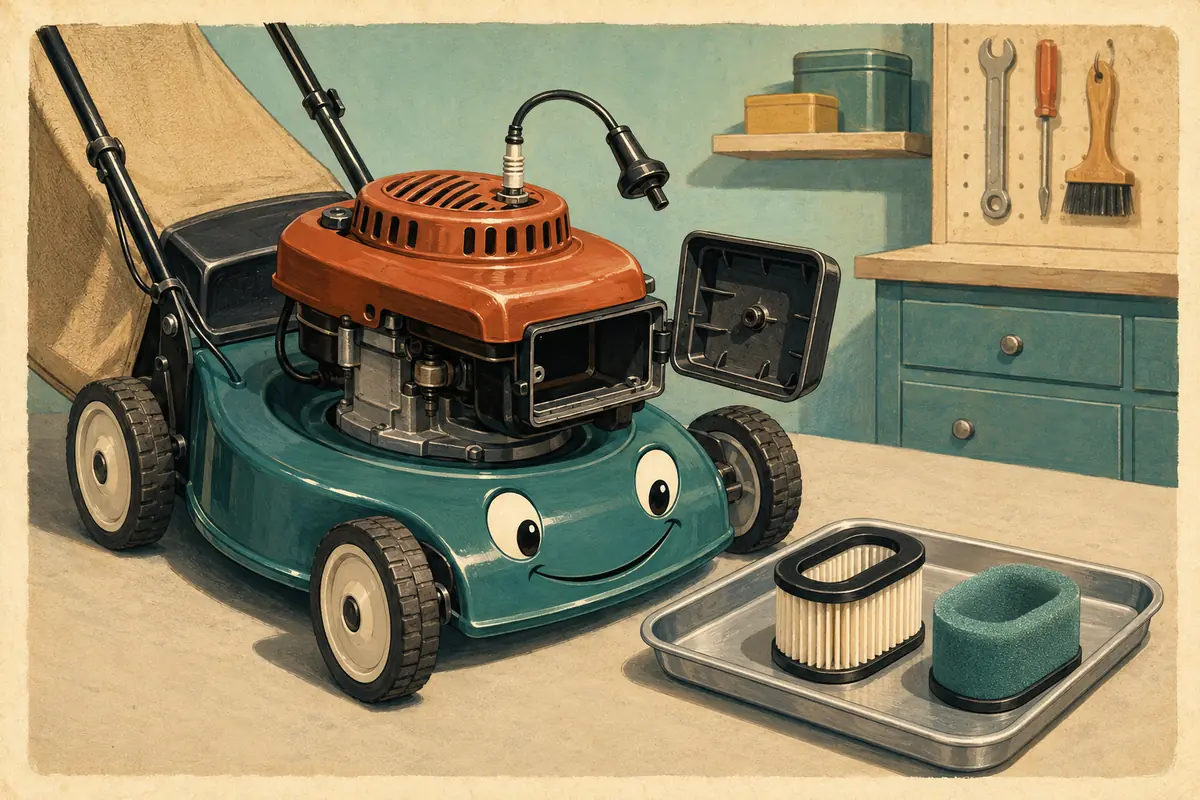
So this is a replacement job with an inspection in front of it. You work out which of the three element types your engine has, take the lead off the spark plug, open the cover, look at what is in there, and fit the correct new element the right way round. The one place oil is involved is the foam element, which Briggs & Stratton says must be oiled — and the pleated paper cartridge, which most people assume is the same thing, is not oiled at all.
Necessary equipment
| Item | Note |
|---|---|
| Screwdriver | Briggs & Stratton gives a cover screw on a paper element housing. |
| Clean cloth | Briggs & Stratton tells you to squeeze a new foam element in a clean cloth. |
| The documentation for your engine | The documentation gives the correct element and the interval for your engine. |
| Flashlight optional | The housing below the element is dark. |
| Camera optional | A photograph of the element in its position helps you at the end. |
| New air filter element for your engine material | The part number is different for each engine model. |
| Fresh engine oil material | Use this on a foam element only. Briggs & Stratton gives no oil for a paper cartridge. |
Find the correct element for your engine
Estimated 8 min to 18 min
Source: How to Replace a Foam Air Filter · tier 1 · accessed 2026-07-29
Source: How to Replace a Dual Element Air Filter · tier 1 · accessed 2026-07-29
Source: How to Replace a Dual Element Air Filter · tier 1 · accessed 2026-07-29
Source: How to Replace a Dual Element Air Filter · tier 1 · accessed 2026-07-29
Source: 22in Recycler Lawn Mower — Operator's Manual · tier 1 · accessed 2026-07-29
No tier-1 source was found for this value. Take it from the documentation supplied with your equipment.
- Find the model number of the engine.3mReport a problem with step 1, Find the correct element for your engine
- The number is usually on a label on the engine.
- Write the number down before you order an element.
USE ONLY THE ELEMENT THAT YOUR DOCUMENTATION GIVES FOR YOUR ENGINE.
Dirt can go into the engine around an element of the wrong type.
- Get the correct element for your engine from the documentation.4mReport a problem with step 2, Find the correct element for your engine
- An engine has a paper element, a foam element or a dual element.
- A dual element has a foam pre-cleaner around a paper cartridge.
- Get the new element before you open the cover.1mReport a problem with step 3, Find the correct element for your engine
- Briggs & Stratton and Toro both give a new element and not a cleaned element.
Isolate the mower
Estimated 3 min to 31 min
- Set the engine control to STOP.<1mReport a problem with step 1, Isolate the mower
- Wait until the engine stops.
DISCONNECT THE LEAD FROM THE SPARK PLUG BEFORE YOU OPEN THE AIR FILTER COVER.
The engine can start. The blade turns with the engine and can cut your hand.
- Disconnect the lead from the spark plug.<1mReport a problem with step 2, Isolate the mower
- Toro tells you to do this before all maintenance.
- Briggs & Stratton gives this as the first step of a spark plug service.
- Move the lead away from the spark plug.
LET THE ENGINE BECOME COOL BEFORE YOU TOUCH THE AIR FILTER COVER.
The engine and the muffler stay hot after use. They can burn your skin.
- Let the engine become cool.2mReport a problem with step 3, Isolate the mower
- The muffler stays hot for a long time after use.
Open the air filter cover
Estimated 3 min to 5 min
- Find the air filter cover on the engine.1mReport a problem with step 1, Open the air filter cover
- The cover is a plastic box on the side of the engine.
- Clean the outer surface of the cover.1mReport a problem with step 2, Open the air filter cover
- Loose dirt on the cover can fall into the engine when the cover is open.
- Open the cover.1mReport a problem with step 3, Open the air filter cover
- Toro tells you to press the latch tabs on top of the cover.
- Briggs & Stratton tells you to loosen the cover screw on a paper element housing.
- Briggs & Stratton tells you to remove the knobs on a dual element housing.
Examine the element
Estimated 3 min
Source: 22in Recycler Lawn Mower — Operator's Manual · tier 1 · accessed 2026-07-29
- Make a photograph of the element in its position.<1mReport a problem with step 1, Examine the element
- The photograph shows you the correct position of the new element.
- Look at the element.<1mReport a problem with step 2, Examine the element
- Toro tells you to look for dirty, loose or damaged parts.
- Briggs & Stratton tells you to replace an element that is very dirty or damaged.
- Look at the pleats of a paper cartridge for dirt.<1mReport a problem with step 3, Examine the element
- The paper holds the dirt on its outer surface.
- Light through the paper is a sign of damage.
- Look at a foam element for damage and for dry areas.<1mReport a problem with step 4, Examine the element
- Briggs & Stratton says that the oil in the foam traps the dirt.
Install the new element
Estimated 8 min to 11 min
No tier-1 source was found for this value. Take it from the documentation supplied with your equipment.
DO NOT LET DIRT FALL INTO THE OPENING BELOW THE ELEMENT.
Dirt that goes into the engine causes wear.
- Remove the element from the housing.1mReport a problem with step 1, Install the new element
- Briggs & Stratton tells you to remove the paper cartridge carefully and to discard it.
- Lift the element straight out of the housing.
- Clean the metal parts of the housing.2mReport a problem with step 2, Install the new element
- Briggs & Stratton tells you to clean all the metal parts of the assembly.
PUT OIL ONLY ON A FOAM ELEMENT.
Briggs & Stratton gives no oil for a paper cartridge.
- If your engine has a foam element, put fresh engine oil into the new foam.2mReport a problem with step 3, Install the new element
- Briggs & Stratton tells you to saturate the new foam with fresh engine oil.
- Briggs & Stratton says that you must put oil on a foam element regularly.
- If your engine has a foam element, remove the extra oil from the foam.1mReport a problem with step 4, Install the new element
- Briggs & Stratton tells you to wrap the foam in a clean cloth and to squeeze it.
- Install the new element in the housing.2mReport a problem with step 5, Install the new element
- Briggs & Stratton tells you to install a paper cartridge with the pleat out.
- Briggs & Stratton tells you to install a foam element so that the lip goes over the edge of the body.
- Compare the position with your photograph.
- If your engine has a pre-cleaner, install the pre-cleaner.<1mReport a problem with step 6, Install the new element
- Put the pre-cleaner around the paper cartridge.
- Briggs & Stratton says that the pre-cleaner increases the life of the paper cartridge.
Close the cover
Estimated 2 min
- Close the cover.<1mReport a problem with step 1, Close the cover
- Make sure that no part of the element is below the edge of the cover.
- Tighten the screw or the knob.<1mReport a problem with step 2, Close the cover
- Briggs & Stratton tells you to tighten the cover screw securely.
- Briggs & Stratton tells you to retighten the knobs securely.
- Examine the edge of the cover for a gap.<1mReport a problem with step 3, Close the cover
- A gap at the edge of the cover lets dirt into the engine.
Record the work
Estimated 1 min
- Connect the lead to the spark plug.<1mReport a problem with step 1, Record the work
- Write the date and the hours of use in your records.<1mReport a problem with step 2, Record the work
- The intervals for this work are in hours of use and not in months only.
Terminology
This page uses one term for each item and holds it throughout, as ASD-STE100 requires. Equipment sellers and other guides use the names below for the same parts.
- air filter element
- Also called: air filter, mower air filter, lawn mower filter, air cleaner element, engine filter, the sponge in the mower, the paper thing in the mower
- paper cartridge
- Also called: paper filter, pleated filter, cartridge filter, the pleated one, cardboard filter
- foam element
- Also called: foam filter, sponge filter, oil foam filter, the sponge, spongy air filter
- pre-cleaner
- Also called: precleaner, pre filter, prefilter, outer foam wrap, the sponge around the filter
- air filter cover
- Also called: air cleaner cover, filter housing cover, the black plastic box on the engine, filter lid
When to use a professional
Stop if the element is wet with oil. A paper cartridge that is wet with oil is a sign of a different fault. Speak to a service dealer before you use the mower again.
Stop if you cannot find the correct element for your engine. Do not install an element that is nearly the correct size. An element that does not seal lets dirt into the engine.
Stop if the housing has a crack, or if the cover does not close fully. The housing must seal fully. A dealer must replace a housing that has damage.
Stop if the engine is difficult to start after you install a new element. This page does not give an engine diagnosis. Speak to a service dealer.
Stop if you see black smoke from the engine. Do not continue to use the mower. A dealer must look at the engine.
Do not disassemble the carburetor. This page ends at the air filter housing.
Common questions
How do I clean a lawn mower air filter?
Honestly: according to the manufacturers, you do not. Briggs & Stratton publishes instructions for all three of its element types and every one of them says remove the old element, discard it and fit a new one. Toro's operator manual says replace the air-filter element. None of them publishes a washing, tapping or blowing-out method, so this page does not print one either. If your engine's own manual gives a cleaning method, follow that — it is the authority for your engine and this page is not.
Can I wash the foam filter in warm soapy water and reuse it?
That method is everywhere on the internet and it is not in any manufacturer document we read for this page. Briggs & Stratton's published foam procedure is the opposite of reuse: discard the old foam, saturate a new foam element with fresh engine oil, then squeeze the excess out in a clean cloth. A method that exists only on third-party sites is unverified by definition here, however many sites repeat it. Check your own engine manual, because some manufacturers genuinely do publish a wash procedure — but we could not confirm one, so we will not tell you to do it.
How often should I change the mower air filter?
It depends which element you have, and the published numbers are worth knowing. Briggs & Stratton: foam every 3 months or 25 hours, whichever comes first; a dual-element pre-cleaner every 25 hours or every season; the paper cartridge behind a pre-cleaner every 100 hours, or every 25 hours if there is no pre-cleaner. Toro: replace the element every 25 hours on the 22in Recycler, and check it before every use. All of these say more often in dusty conditions. Note they are in engine hours, not calendar months, which is why the last step of this page is to write the hours down.
Do I need to oil the air filter?
Only if it is foam. Briggs & Stratton is explicit that a foam-only element must be oiled and serviced regularly, because the oil in the foam is what actually traps the dirt — a dry foam filter catches only the largest particles and is close to useless. A pleated paper cartridge is a completely different thing and Briggs gives no oil for it at all. Oiling a paper filter is the classic mix-up between the two.
What happens if I run the mower with a dirty air filter, or with no filter at all?
Briggs & Stratton's stated purpose for the filter is to keep dirt out of the engine, and it warns that dirt drawn into the carburetor causes premature engine wear and can block the small passages, which shows up as hard starting or poor running. So a clogged filter chokes the engine and a missing one lets grit straight into it. Neither is a same-day disaster and both shorten the engine's life. Fit the correct element and close the cover properly.
Which type of filter does my mower have?
Open the cover and look. A pleated cartridge that looks like folded cardboard is a paper element. A soft yellow or grey sponge is a foam element. A paper cartridge with a sponge sleeve wrapped around the outside is a dual element, and the sleeve is the pre-cleaner. The three are not interchangeable and each has its own replacement interval, so identifying yours is genuinely the first step and not a formality.
Do I really have to pull the spark plug wire off just to change a filter?
Yes. Toro's instruction is to disconnect the spark-plug wire before any maintenance procedure, and Briggs & Stratton starts its own engine service with the same step. A petrol engine needs no key and no battery to fire, and the air filter housing sits right next to the parts you would rather not have moving. It costs five seconds and it is the only thing standing between your hand and a blade that turns with the engine.
Related procedures
- How to find and record the model and serial number of every appliance in the house
- How to clean or change the air filter on a portable generator
- How to change the spark plug on a lawn mower
- How to change the engine air filter in your car
- My vacuum has lost suction — can I just wash the filter?
- What size blade fits my mower, and how do I check the length, center hole and mounting pattern before I buy a replacement?
Sources
Every specification on this page is traced to one of these sources. Tier 1 is a manufacturer document, a published standard, or a government safety authority. See Standards for the full tiering rule.
- Tier 1How to Change a Small Engine Air Filter
- Tier 1How to Replace a Foam Air Filter
- Tier 1How to Replace a Dual Element Air Filter
- Tier 122in Recycler Lawn Mower — Operator's Manual
- Tier 1How do I check, clean and change small engine spark plugs?
Revision history
Current version 1 · updated 2026-07-29 · next review due 2027-07-29
- v1 · 2026-07-29First draft. Sourced to three Briggs & Stratton air filter articles and the Toro 22in Recycler operator manual, with Briggs & Stratton for the isolation instruction. The page publishes replacement rather than cleaning because that is what every manufacturer source read for it publishes; the wash-and-reuse method that dominates third-party results was not found in any primary source and is recorded as unverified rather than printed. Six intervals publish as verified and attributed to the manufacturer that gives each one — they differ by element type, not by disagreement, so no conflict_note is set. The verified specifications carry no spec_key because data/specs.json is written centrally after the merge; the registry entries should be added there.
Corrections to this page are listed in the public corrections log. Reports that are credible and not yet verified are listed in the public errata register, and an open one renders above the step it concerns.
Comments and corrections
Found an error? A correction with a manufacturer source is applied and logged publicly. You can also write to corrections@fixchecklist.com.
Every step above carries its own report control, which tags the report with that step so a correction reaches the right place. For anything about the procedure as a whole — the order of the sections, a step that is missing, something that did not match your equipment — use this: report something about this whole procedure.