Before you begin. This procedure is general reference information, not professional advice. Equipment varies by manufacturer, model, and year. Always follow the documentation supplied with your equipment — where it differs from this page, follow the manufacturer. Verify that you have the tools, the working conditions, and the ability to do this task safely. If anything is unclear, if the equipment is damaged, or if the task exceeds your experience, stop and use a qualified professional. You are responsible for your own safety and for the outcome. This site accepts no liability for any loss, damage, or injury arising from the use of this information.
Specifications marked unverified could not be traced to a manufacturer source. Do not rely on them — obtain the value from your equipment documentation.
Summary
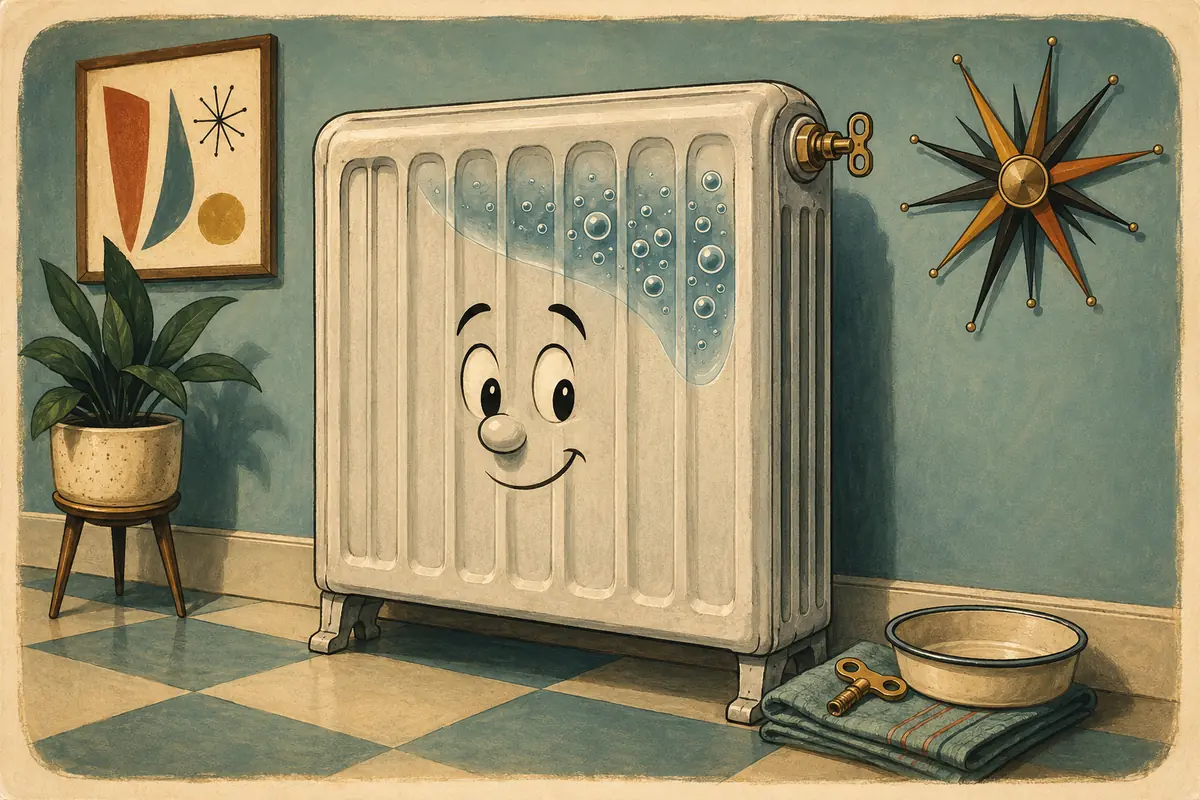
A radiator that is cold at the top and warm at the bottom almost always has air trapped inside it. The air collects above the water, keeps the top of the panel from heating up, and leaves the room cool while the boiler runs longer than it needs to. Letting that air out through the small valve at the top corner of the radiator is called bleeding, and it needs a key that costs very little and about a minute of actual work per radiator. Most of the job is waiting, because the heating has to be off and the radiator cold before you open anything.
This page gives the sequence and the boundary, and it prints no numbers you would have to trust. It does not print the pressure your boiler should show afterwards, because that figure belongs to your boiler and your installation and not to the radiator. It does not print a waiting time either: two manufacturers publish different ones, and that disagreement is recorded on this page rather than averaged away. If your radiator is cold at the bottom instead of the top, this is the wrong page, and the boundary section says what it is telling you instead.
Necessary equipment
| Item | Note |
|---|---|
| Radiator bleed key | The bleed key must fit the bleed valve of your radiator. |
| Cloth | A cloth catches the water that comes from the bleed valve. |
| Small container | A container catches the water that comes from the bleed valve. |
| Flat screwdriver optional | Only if the bleed valve has a slot and not a square spindle. |
| Gloves optional | Gloves give protection to your hands. |
Specifications
No tier-1 source was found for this value. Take it from the documentation supplied with your equipment.
Find the radiator with trapped air
Estimated 3 min
- Touch the top and the bottom of each radiator.2mReport a problem with step 1, Find the radiator with trapped air
- A radiator with trapped air is cold at the top and warm at the bottom.
- Trapped air does not cause the opposite condition.
- Write a list of each radiator that is cold at the top.1mReport a problem with step 2, Find the radiator with trapped air
Prepare the radiator and the floor
Estimated 33 min to 2 hr 3 min
No tier-1 source was found for this value. Take it from the documentation supplied with your equipment.
SET THE HEATING SYSTEM TO OFF.
WAIT UNTIL EACH RADIATOR IS COLD BEFORE YOU OPEN A BLEED VALVE. Water in a hot radiator can burn your skin.
- Set the heating system to off.<1mReport a problem with step 1, Prepare the radiator and the floor
- Wait until each radiator is cold.30mReport a problem with step 2, Prepare the radiator and the floor
- Manufacturers do not agree about the time. The specification for this step gives both figures.
- Touch the radiator to make the test. The radiator must be cold before you open the bleed valve.
- Get a bleed key that fits the bleed valve.2mReport a problem with step 3, Prepare the radiator and the floor
- The bleed valve is at the top of the radiator, at one end.
- Some bleed valves have a square spindle, and some have a slot for a screwdriver.
- Put a cloth on the floor below the bleed valve.<1mReport a problem with step 4, Prepare the radiator and the floor
- Hold a container below the bleed valve.<1mReport a problem with step 5, Prepare the radiator and the floor
Release the air from the radiator
Estimated 3 min to 4 min
No tier-1 source was found for this value. Take it from the documentation supplied with your equipment.
- Put the bleed key on the spindle of the bleed valve.<1mReport a problem with step 1, Release the air from the radiator
DO NOT REMOVE THE BLEED VALVE FROM THE RADIATOR.
TURN THE BLEED KEY ONLY UNTIL YOU HEAR AIR. Water at high temperature can come from an open hole and burn your skin.
Turn the bleed key slowly.
Water from the bleed valve can cause damage to the floor and to the wall.
- Turn the bleed key slowly counterclockwise until you hear air.<1mReport a problem with step 2, Release the air from the radiator
- Do not turn the bleed key more than necessary.
- Keep the container below the bleed valve.<1mReport a problem with step 3, Release the air from the radiator
- Wait until water comes from the bleed valve.<1mReport a problem with step 4, Release the air from the radiator
- The sound of air stops when the water starts.
- Turn the bleed key clockwise immediately to close the bleed valve.<1mReport a problem with step 5, Release the air from the radiator
- Close the bleed valve until the flow of water stops.
- Do not use more force than necessary on the bleed key.
- Make sure that no water comes from the bleed valve.<1mReport a problem with step 6, Release the air from the radiator
- Dry the radiator and the floor with the cloth.<1mReport a problem with step 7, Release the air from the radiator
After the job
Estimated 25 min to 35 min
No tier-1 source was found for this value. Take it from the documentation supplied with your equipment.
No tier-1 source was found for this value. Take it from the documentation supplied with your equipment.
- Do this procedure again at each radiator on your list.5mReport a problem with step 1, After the job
Read the pressure gauge of the boiler after you bleed the radiators.
Air removal decreases the pressure of the system.
- Read the pressure gauge of the boiler.<1mReport a problem with step 2, After the job
- Compare the reading with the correct value in the documentation of the boiler.2mReport a problem with step 3, After the job
- Set the heating system to on.<1mReport a problem with step 4, After the job
- Wait until the radiators are warm.15mReport a problem with step 5, After the job
- Touch the top of each radiator again.2mReport a problem with step 6, After the job
- Write the date and the identification of each radiator that you bled.1mReport a problem with step 7, After the job
Terminology
This page uses one term for each item and holds it throughout, as ASD-STE100 requires. Equipment sellers and other guides use the names below for the same parts.
- bleed valve
- Also called: air vent, bleed screw, bleeder valve, radiator air valve, bleed nipple, vent valve
- bleed key
- Also called: radiator key, radiator bleed key, bleeding key, radiator valve key
- radiator
- Also called: rad, heater, hot water radiator, panel radiator, baseboard heater, wall heater
- central heating system
- Also called: boiler system, hydronic heating, hot water heat, wet heating system, water heating system
- trapped air
- Also called: airlock, air lock, air pocket, air in the radiator, air in the system
- system pressure
- Also called: boiler pressure, pressure gauge reading, water pressure on the boiler
When to use a professional
Stop if the radiator is warm at the top and cold at the bottom. Trapped air does not cause that condition. Bosch Thermotechnology tells the owner that debris in the radiator can cause it. A system flush is installer work. Speak to a qualified service technician.
Stop if water continues to come from the bleed valve after you close it. Stop if the bleed valve turns with no resistance. Stop if the bleed valve has damage. Speak to a qualified service technician.
Stop if the pressure of the system is not correct after you bleed the radiators. Do not add water to the heating system without the documentation of the boiler. Speak to a qualified service technician.
Stop if the radiators need air removal each month. That condition shows a fault in the system. Weil-McLain tells the owner to get repair of leaks immediately. New water in the system can cause damage to the boiler. Speak to a qualified service technician.
Do not open the air vent of a steam radiator. A steam system is different equipment. This procedure is not correct for a steam system. Speak to a qualified service technician.
Common questions
Why is my radiator cold at the top and hot at the bottom?
That is the classic sign of air trapped in the radiator. Air is lighter than water, so it collects along the top of the panel and the hot water can only fill the part below it. Bleeding lets the air out and the water back in. If the pattern is the other way round, cold at the bottom and warm at the top, bleeding is not the fix and the boundary section on this page says what to do instead.
How long should I wait after turning the heating off before bleeding a radiator?
The manufacturers do not agree, and this page will not pretend they do. Worcester Bosch's homeowner guide says to turn the heating off for around 30 minutes to let the system cool. Vaillant says to wait about an hour, or two hours to be cautious, so that every radiator is cold. A third manufacturer guide, from Ideal Heating, gives no waiting time at all. Use the radiator rather than the clock: it must be cold to the touch before you open its valve, and if your own boiler documentation gives a figure, that figure wins.
What is a radiator bleed key, and can I use something else?
It is a small key, often described as butterfly-shaped, that fits over the square spindle in the middle of the bleed valve. Ideal Heating notes that some valves take a flat screwdriver or a spanner instead, so look at your own valve before you buy anything. Keys are sold in hardware shops and cost very little. Buy the type that matches the valve rather than forcing the wrong tool onto the spindle, which is how the spindle gets rounded off.
Do I have to bleed every radiator in the house?
No. Bleed only the ones that are cold at the top, and work through them in one session so the boiler is only disturbed once. Every radiator you bleed takes a little water out of the system, so check the pressure gauge once at the end rather than after each one.
What pressure should my boiler be at after bleeding?
This page does not print a number, on purpose. Releasing air lowers the pressure of a sealed heating system, so the gauge does have to be read afterwards, but the correct reading is a property of your boiler and your installation rather than of the radiator. The manufacturers we read give figures for their own equipment, in different units, and one of them gives a maximum rather than a target. Read the documentation that came with your boiler, or ask the installer who commissioned it. Refilling a heating system is boiler work, and if the pressure keeps falling that is a fault to report rather than a level to keep topping up.
My radiator still is not heating up after bleeding. What now?
If no air came out at all, air was not the problem. If the radiator is now warm at the top but cold at the bottom, Worcester Bosch says that points to a build-up of debris inside the radiator, and clearing that means a system flush by an installer. If the same radiator needs bleeding again within weeks, treat that as a fault rather than a chore: Weil-McLain's user manual tells owners to have leaks repaired at once, because constantly adding fresh water damages a boiler from the inside.
Related procedures
- Where is the water under my hot water heater coming from, and does it mean I need a new one?
- How to flush a water heater
- How to change the air filter in a furnace or central air conditioner
- How do I insulate the hot water pipes at my water heater
- How to replace a thermostat and get the wires on the right terminals
Sources
Every specification on this page is traced to one of these sources. Tier 1 is a manufacturer document, a published standard, or a government safety authority. See Standards for the full tiering rule.
- Tier 1How to bleed your radiators — Homeowner guide
- Tier 1How to bleed a radiator (support troubleshooting FAQ)
- Tier 1How to bleed a radiator
- Tier 1How to Bleed a Radiator – a Guide to Fixing Cold Radiators
- Tier 1Gas-Fired Boilers User Manual — CGa, CGi, EG, PEG and LGB series, part number 550-142-301/0224
Revision history
Current version 1 · updated 2026-07-29 · next review due 2027-07-29
- v1 · 2026-07-29First draft. Five tier-1 manufacturer sources; every specification publishes as a consult-the-documentation instruction because no value could be registered in data/specs.json from this session. The Bosch and Vaillant disagreement about the cooling time is published as a conflict_note rather than reconciled.
Corrections to this page are listed in the public corrections log. Reports that are credible and not yet verified are listed in the public errata register, and an open one renders above the step it concerns.
Comments and corrections
Found an error? A correction with a manufacturer source is applied and logged publicly. You can also write to corrections@fixchecklist.com.
Every step above carries its own report control, which tags the report with that step so a correction reaches the right place. For anything about the procedure as a whole — the order of the sections, a step that is missing, something that did not match your equipment — use this: report something about this whole procedure.